
Backend settings & keep-alive
Where the backend lives in the editor, what keep-alive does and costs, how to disable and re-enable a backend, and how environments work on Free and Pro.
If your app stores anything — bookings, orders, form submissions, user accounts — it runs on a managed backend that MeDo creates alongside the pages. You manage it from the Backend view in the editor. This page covers the settings that decide whether the backend is running when your users need it.
Open the Backend view
In the editor, click the Backend icon in the left rail. The Overview tab shows the backend's status (normally Running), a Disable / View pair of buttons, and the Backend Keep-Alive switch.
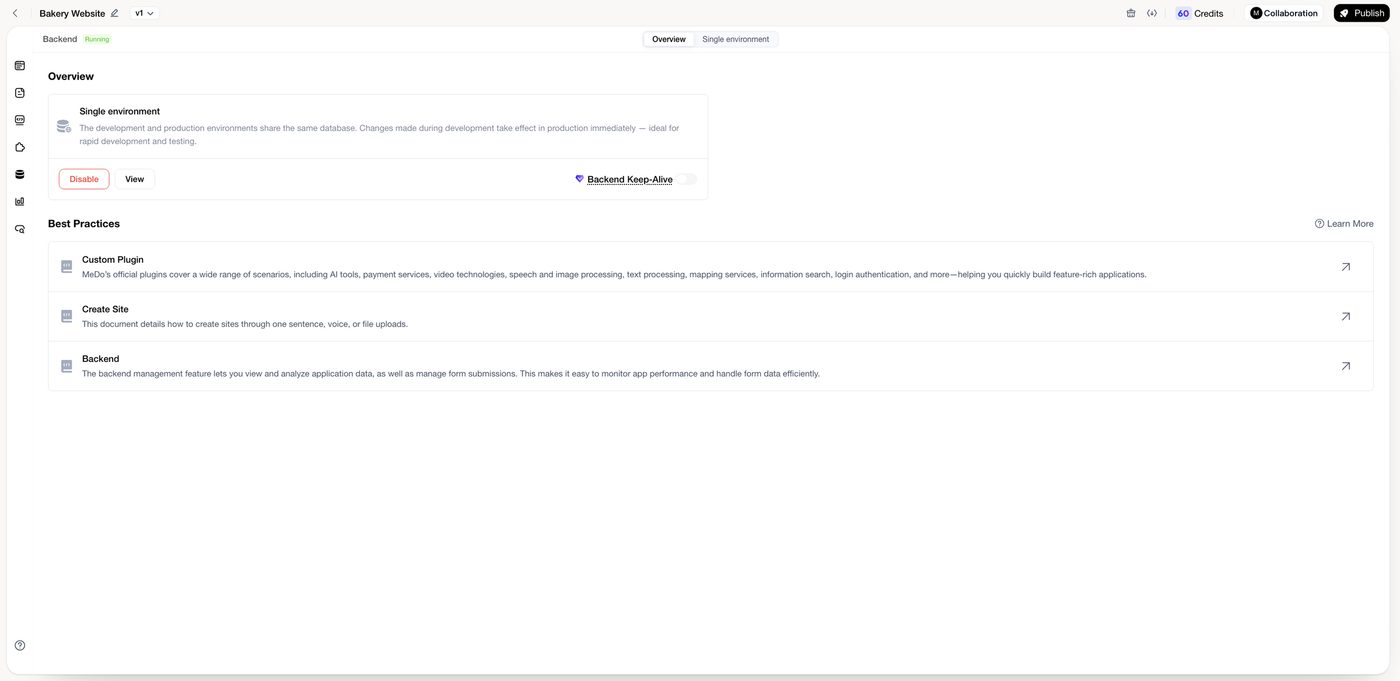
The second tab opens the data tools — tables, users, functions, secrets, and scheduled tasks — described in App data & forms.
What a running backend costs
A backend that is enabled is billed 15 credits per app per day at the basic size. If several apps share one backend, each of them pays its own daily fee. The pages of your app are free to host; only the backend is metered. See Credit System.
Keep-alive: the setting that matters for real users
On the Free plan, a backend that sees five consecutive days without project activity is paused. The published pages still open, but sign-in, forms, and anything that reads or writes data stop working until the backend is running again.
Backend Keep-Alive prevents that pause. It is a Pro and Max feature, and MeDo offers to turn it on the first time you publish an app that has a backend:
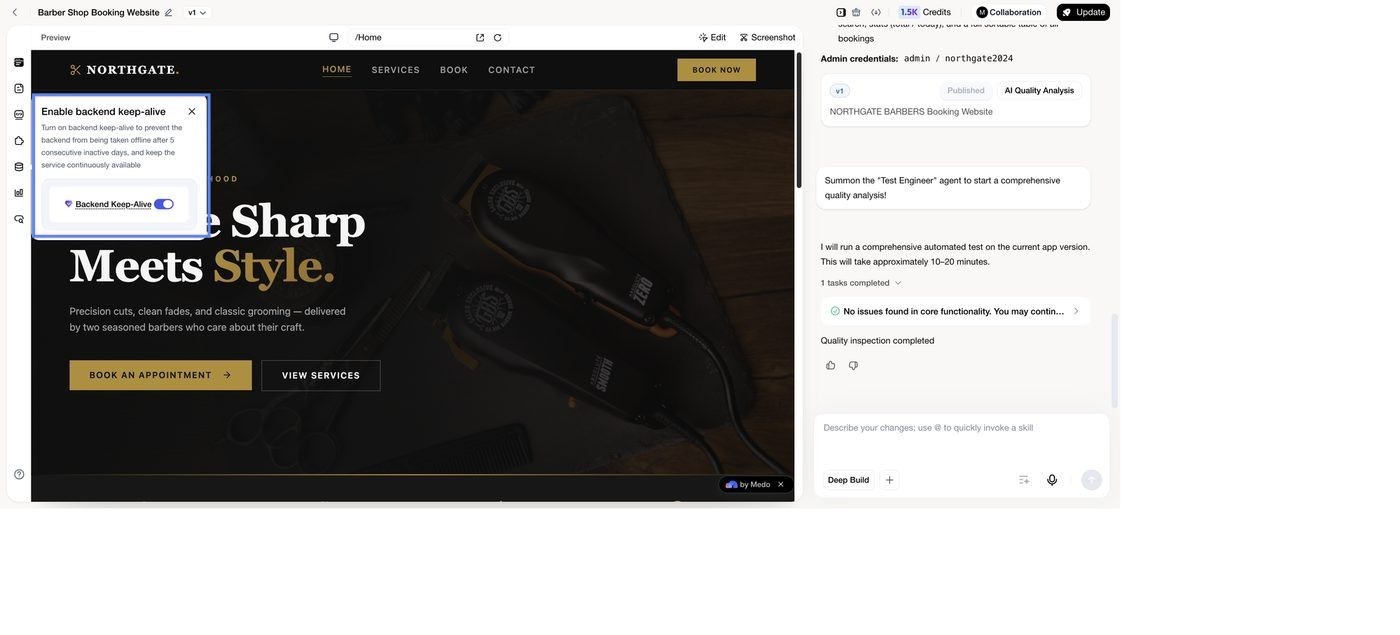
You can also switch it on or off at any time from the Overview tab. Turn it on for any app that customers rely on; leave it off for prototypes you only open yourself.
Disable and re-enable
Between projects, or while an app is parked, you can stop paying for the backend:
- Disable (Overview tab) turns the backend off. Your data is kept, daily charges stop, and the app cannot read or write data until you enable it again.
- To bring it back, open the same tab and enable the backend. Existing tables, users, and files are still there.
If sign-in, forms, or saved data suddenly stop working on a published app, this is the first thing to check: the backend is either disabled or paused after inactivity.
Environments
Every app starts with a single environment: development and production share one database. This is fine while you are building, but it means test bookings end up in the same table as real ones.
On Pro and Max you can run multiple backend environments, so you can make and check changes against development data and apply them to production when they are right. The environment tab in the Backend view tells you which mode your app is in.
Reuse one backend across several apps
When creating a new app you can point it at an existing project's backend instead of provisioning a new one — useful when a website, an admin console, and a mobile app should share the same customers and orders. See Sharing a backend.